This report is divided in two sections: the first one deals with the Cope rearrangement. The second concerns the Diels-Alder reaction.
Cope rearrangement studies
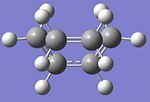
This section will look into the optimisation of the reactants and products for the Cope rearrangement and the boat and chair transition state localisation on the C6H10 potential energy surface. These considerations will allow us to determine the preferred reaction mechanism (lowest activation energy).
Reactant optimisation to an energy minimum
Several isomers of 1,5-hexadiene exist:
Conformation
Image
Optimisation method/basis set
Energy (hartree)
Energy (kJ/mol)
Point group
Anti2
HF/3-21G
-231.69254
-608,308.81
Ci
Anti1
HF/3-21G
-231.69260
-608,308.97
C2
Gauche2
HF/3-21G
-231.69167
-608,306.53
C2
Gauche3
HF/3-21G
-231.69266
-608,309.13
C1
Anti2
B3LYP/6-31G(d)
-234.61172
-615,973.11
Ci
As can be noticed above, the geometry of Anti 2 does not change much, regardless of the level of theory adopted. However, the energy becomes lower when we use a more precise basis set, as the structure gets stabilised even further.
Frequency analysis allows us to determine that the structure of Anti 2 obtained is, in fact, a minimum. Since the low frequencies in the log file are more or less between +- 10 cm-1, we can conclude that the optimisation was successful (but not great).
There are no negative (imaginary) frequencies. This confirms that the structure is not a maximum (a T.S.).[1]
Thermochemical analysis of Anti 2 revels that:
The sum of its electronic PE at 0K and its zero-point energy is -234.469182 hartree = - 615598.88 kJ/mol
The sum of its electronic PE at 298.15K, 1atm and thermal energies (vib, rot, trans contributions) is -234.461844 hartree = - 615579.62 kJ/mol
The sum of its electronic and thermal enthalpies (includes an RT correction) is -234.460900 hartree = - 615577.14 kJ/mol
The sum of its electronic and thermal free energies (includes entropy) is -234.500730 hartree = - 615681.71 kJ/mol
In fact, the first value Ee- + ZPE = -234.46918 au; that minus the ZPE 0.14254 au (from the log file) gives Ee-= -234.61172 au. This value matches the one previously obtained (see Anti 2, B3LYP/6-31G(d) method in the table at the start of this section).
"Transition state optimisation"
The Optimisation of the chair TS of the Cope rearrangement was also done exploiting the HF/3-21G basis set and, while the first attempt was done using a force constant matrix, the second included redundant coordinates editing (first restricting the distance of the 2 fragments, then allowing them to reorientate). The two methods gave similar final structures. However, both optimisations did not run smoothly from the start. Firstly, an error message suggested the use of a single processor rather than 4 (as the jobs were being run on the laptop). Then, the initial structure of the two starting allyl fragments had to be modified to fit symmetry requirements. Only at this point the jobs run smoothly.
Chair structure optimisation details
Force constant
Redundant
separation between fragments
2.02
2.02
bond breaking bond lengths
1.39
1.39
optimised fragments image
widthpx
widthpx
Energy (au)
-231.61932238
-231.61932198
Energy (kJ/mol)
-608116.57723
-608116.57618
Imaginary frequencies (cm-1)
818 (corresponds to Cope rearrangement)
818 (corresponds to Cope rearrangement)
The boat transition structure, instead, was found by using QST2. The reactant and product - from which Gaussian interpolated the TS structure - were drawn in such a way that the structure resembled that of the boat TS in H.Jiao and P.v Ragué Schleyder's paper. [2]. Also, the atom numbering of the reactant and product was matched as to allow Gaussian to recognise the Cope rearrangement, as shown below (all measurements are in Å, the central C-C-C-C dihedral angle is 0°).
Furthermore, I added an Opt=maxstep5 command to allow the TS not to be "missed" in the interpolation. The resulting output displays a single imaginary frequency at 836 cm-1, corresponding to the Cope rearrangement. Hence, the optimised TS structure is:
Now, what will the optimised transition structures lead to?
Intrinsic reaction coordinate (IRC) calculations
The IRC calculation was set up in the forward direction of the reaction coordinate (since it is symmetric). Force constants were calculated at the beginning of the job. 50 points along the IRC were considered.
Chair transition structure energy profile
Boat transition structure energy profile
The structures obtained were minimised as usual, resulting in the following local minima of energy:
CHAIR conformation local minimum
BOAT conformation local minimum
Activation energy comparison (all in kJ/mol)
Level of theory
DFT/B3LYP/6-31G*
DFT/B3LYP/6-31G
HF/3-21G
HF/3-21G
React.
T.S.
Energy difference = Activation energy
React.
T.S.
Energy difference = Activation energy
Experimental values
BOAT
-615,973
-615,793
180
-608,309
-608,073
236
187+-8.4
CHAIR
-615,973
-615,834
139
-608,309
-608,117
192
140+-2.1
Hence, the experimental values are very close to the computationally predicted ones using DFT/B3LYP/g-31G level of theory. The HF/3-21G theory is not precise enough to accurately predict the activation energies. However, it is still useful to have an idea of their magnitude.
Diels-Alder reaction
This section will look into the transition structures of the Diels-Alder reaction to examine the nature of the reaction path. The discussion will then follow up on the regioselectivity of this reaction (endo/exo)
The optimised geometry of cis-butadiene (B3LYP/3-21G basis set) is:
Notice how the optimised structure has a dihedral angle of 0° between the two extreme carbons.
HOMO
LUMO
The HOMO and the LUMO of the molecule are shown on the left. One can notice how the HOMO is asymmetric with respect to the vertical plane, while the LUMO is symmetrical.
Interestingly, the most external carbons have in the LUMO identical symmetry to the HOMO of ethene, suggesting a wonderful potential overlap.
Also, the alkenes have antibonding character in the LUMO. This orbital is empty, so that explains why they are higher order bonds.
Cs symmetry - notice plane of symmetry The optimised geometry of the prototype Diels Alder reaction is below. This structure optimisation required the initial guess to be symmetrised. Hence, first the alkene was fitted to D2h symmetry. Separately, the diene was allowed to relax in a C2v symmetry conformation. The two structures were then pasted together and modified to fit Cs symmetry requirements. Interfragment distance was set to 2.2Å.
Furthermore, an "Opt=noEigen" command was added to allow the job to avoid eigenvalue checks. Finally, the optimised (output) transition state structure was again Cs symmetric and had the expected imaginary frequency at 818cm-1 and only 1 negative eigenvalue.
Moreover, the imaginary frequency, which can be seen on the right, corresponds to the movements of the bonds required to transform the reactants buatadiene+ethene in the Diels-Alder cyclic product. The bonds are forming synchronously. The lowest positive frequency of 166cm-1 represents a torsion of the dienophile with respect to the butadiene, leading, in such a way, to an asynchronous motion of the partly formed σ C-C bonds.
Vibration motions
Imaginary vibration motion
166 cm-1 vibration
Optimised Diels-Alder transition state and frontier orbital representations
HOMO
LUMO
The HOMO (and the LUMO) of this species are now symmetric with respect to the vertical central plane (differently to the butadiene above).
This fact testifies that the central butadiene bond has become stronger (higher order), while in butadiene, above, the HOMO had antibonding character for the central bond, and bonding character for the side olefinic bonds.
A closer look at the Transition state's MO allows us to realise that this orbital is the sum of the interaction between the ethene's HOMO (bonding and symmetric) and butadiene's LUMO (antibonding and symmetric). Ethene is acting as the electron rich substituent that donates to the LUMO of the electrophilic species. This interaction is allowed as the orbitals have the same character. Practically, though, this Diels-Alder reaction will not happen as readily as, say, that of butadiene with maleic anhydride, the reason being that the more the dienophile is electron rich, the faster the pericyclic rearrangement takes place.
Further considerations can be made regarding the C-C links. The partly formed σ C-C bond lengths are of 2.21Å (vs. lit. 1.526Å of ethane[3]. Also, sp3 C-sp2 C lit. 1.507Å; sp2 C-sp2 C lit. 1.455Å.[4]
Moreover, the VdW radius of C is 1.70Å [5]. Hence, the partial σ C-C bond present in the transition state is actually longer than a normal C-C bond, but still shorter than the sum of the carbons' Van der Waals radii (3.40Å). The T.S. is, in fact, a transition from a non-bonding and non-interacting situation to a bonding one: in the transition state we can see how the carbons have entered each other's zone of influence.
The optimised structures of the exo and endo products are, respectively:
In order to obtain such optimised structures, it was necessary to modify the input geometries so as to fit symmetry requirements The EXO TS guess was fitted to Cs symmetry and optimised using the force constant method. The resulting structure had a single imaginary frequency at 648com-1, corresponding to the DA reaction.
The ENDO t.s. conformer input structure was built by fitting the diene to Cs symmetry and allowing it to have a similar shape to that of the ENDO product of reaction. Separately, the anhydride was drawn to fit D2h symmetry. The maleic anhydride ring was then added, avoiding steric repulsions between the hydrogens, but still keeping the two species 2.2Å close. Finally, the molecule was fitted to Cs symmetry. The output had a single imaginary frequency at 643cm-1, corresponding to the Diels-Alder reaction.
The resulting energies are:
EXO T.S.: -605.60359 au = -1,590,012 kJ/mol
ENDO T.S.: -605.61037 au = -1,590,030 kJ/mol
Information about their geometry (all measures are in Å. The molecule has σv symmetry)
MOs
ENDO HOMO The image above shows the overlap between the diene and the dienophile
EXO HOMO
EXO HOMO widthpx
The image above displays the anti-bonding character of the interaction between the carbonyl oxygen and the sp2 C - sp2 C of the diene
The upper images show the bonding overlap of the diene and the dienophile. The image on the left shows the slight bonding interaction between the oxygens of the carbonyls and the sp3 C - sp2 C of the diene.
The MO images allow us to follow up with a few considerations. Firstly, in both the ENDO and EXO conformations there is a bonding overlap of the diene to the dienophile, in the locations where we expect the formation of 2 new σ bonds. Hence, the reaction "is working" as the species are starting to mix their electronic density.
Secondly, we notice that in the endo and the exo conformers there is a different overlap fashion of the carbonyls to the secondary orbitals of the diene that sits "opposite" to the carbonyls. In the endo structure, this interaction is antibonding; in the exo one, it is bonding. This suggests that the exo structure is more favoured, having a more constructive secondary orbital effect, a more stabilised conformation, a secondary driving force that pushes it towards reactivity. However, the structures' geometric data indicates that the endo's (O=C)-O-(C=O) to sp2 C - sp2 C distance is shorter by a factor of 0.09Å. The (O=C) to sp2 C - sp2 C distance, instead, is equal, suggesting that only the anhydride's central oxygen is bent "outwards" in the exo structure as opposed to the endo structure. Moreover, the anhydride sits closer to the diene in the ENDO conformer.
All this having been said, the energetic data indicates that the endo conformation is more stable by 18kJ/mol. Hence, despite the secondary orbital effect stabilisation in EXO, the endo structure is still the most stable conformer of the two. Most probably, the exo structure has an unfavourable strain due to the way it has to approach the diene: the Diels-Alder reaction works best when the dienophile approaches the diene from below or above. However, the exo conformer cannot allow access from above, due to the bridgehead's sterical interference. So the endo conformer is overall the winning isomer.
Some effects have not been considered in these calculations. For instance, the electronic favourability of the interaction of the maleic anhydride with the diene (due to the electronic richness of the dienophile)[6]:
References
↑Higgins, J. Chem. Educ., 1995, 72 (8),703. DOI: 10.1021/ed072p703
↑H. Jiao, P. von Ragué Schleyer, Angewandte Chemie, 1995, 34, 3, pp. 335, fig. 1.3b. DOI: 10.1002/anie.199503341
↑Lide, D.R., A survey on C-C bond lengths, Tetrahedron, 1962, 17, 125
↑Allen, Kennard et al., J. Chem. Soc. Perkin Trans. II, 1987, S1-S19