
Rep:Mod:Mbi31M90Proj
Y3C INORGANIC MODULE: Investigating Aromaticity
In this project, the aromaticity of benzene and some of its isoelectronic analogues were investigated by using Gaussian calculations to visualise the molelcular orbitals. The following is a summary of the computational procedures used and a discussion into the effect of substituting carbons in benzene for boron or nitrogen. This will demonstrate the effect of reducing the symmetry of an aromatic compound on its non-core orbitals, their shapes, energies and degeneracy, as well as providing a more complete understanding of the overall bonding.
Aromaticity is first introduced as a concept which follows some simple rules:
- •there must be 4n+2 π electrons
- •the molecule must be planar
- •the π electrons must be delocalised in a conjugated π system [1]
These rules do apply to the molecules being examined here, however it will be seen in this investigation that Molecular Orbital Theory plays an important role in aromaticity and that in fact these rules may be broken.
Optimisations
Benzene
| File Name | LKB_BENZENE_OPT | LKB_BENZENE_OPT_D6H |
| File Type | .log | .log |
| Calculation Type | FOPT | FOPT |
| Calculation Method | RB3LYP | RB3LYP |
| Basis Set | 6-31G(d,p) | 6-31G(d,p) |
| E(RB3LYP) | -232.25820551 a.u. | -232.25821387 a.u. |
| RMS Gradient Norm | 0.00009550 a.u. | 0.00008450 a.u. |
| Dipole Moment | 0.00 Debye | 0.00 Debye |
| Point Group | C1 | D6H |
| Calculation Time (s) | 25 | 7 |
| Link to .log File | View file | View file |
A molecule of Benzene was constructed in GaussView and optimised using the 6-31G(d,p) basis set. No symmetry constraints or keywords were used. The resulting structure was assigned the C1 point group.
The optimisation was repeated, with the point group constrained to D6h. The table to the right displays the calculation. summaries for both the optimisations. The two calculations generated similar values for energy, illustrating that the D6h structure is in fact optimal.
A link to the .log files for each calculation has been included in the table, and the "Items" tables to confirm completion have been copied below.
Symmetry broken optimisation:
         Item               Value     Threshold  Converged?
 Maximum Force            0.000212     0.000450     YES
 RMS     Force            0.000085     0.000300     YES
 Maximum Displacement     0.000991     0.001800     YES
 RMS     Displacement     0.000315     0.001200     YES
 Predicted change in Energy=-5.157444D-07
 Optimization completed.
    -- Stationary point found.
Symmetry constrained optimisation:
         Item               Value     Threshold  Converged?
 Maximum Force            0.000199     0.000450     YES
 RMS     Force            0.000081     0.000300     YES
 Maximum Displacement     0.000847     0.001800     YES
 RMS     Displacement     0.000299     0.001200     YES
 Predicted change in Energy=-4.636845D-07
 Optimization completed.
    -- Stationary point found.
A similar proceedure was carried out for the optimisations of various analogues of benzene: the boratabenzene and pyridinium anions, and borazine. Relevant charges were included in the method for the anions. Below are the summaries and relevant extracts from .log files for each optimisation.
Boratabenzene
| File Name | lkb_borata_opt | lkb_borata_opt_c2v |
| File Type | .log | .log |
| Calculation Type | FOPT | FOPT |
| Calculation Method | RB3LYP | RB3LYP |
| Basis Set | 6-31G(d,p) | 6-31G(d,p) |
| Charge | -1 | -1 |
| E(RB3LYP) | -219.02052984 a.u. | -219.02052981 a.u. |
| RMS Gradient Norm | 0.00015840 | 0.00016352 |
| Dipole Moment | 2.85 Debye | 2.85 Debye |
| Point Group | C1 | C2V |
| Calculation Time | 41 | 20 |
| Link to .log file | View file | View file |
Symmetry broken optimisation:
         Item               Value     Threshold  Converged?
 Maximum Force            0.000159     0.000450     YES
 RMS     Force            0.000069     0.000300     YES
 Maximum Displacement     0.000878     0.001800     YES
 RMS     Displacement     0.000326     0.001200     YES
 Predicted change in Energy=-6.589475D-07
 Optimization completed.
-- Stationary point found.
Symmetry constrained optimisation:
         Item               Value     Threshold  Converged?
 Maximum Force            0.000158     0.000450     YES
 RMS     Force            0.000071     0.000300     YES
 Maximum Displacement     0.000900     0.001800     YES
 RMS     Displacement     0.000327     0.001200     YES
 Predicted change in Energy=-6.854764D-07
 Optimization completed.
-- Stationary point found.
Pyridinium
| File Name | lkb_pyr_opt | lkb_pyr_opt_c2v |
| File Type | .log | .log |
| Calculation Type | FOPT | FOPT |
| Calculation Method | RB3LYP | RB3LYP |
| Basis Set | 6-31G(d,p) | 6-31G(d,p) |
| Charge | 1 | 1 |
| E(RB3LYP) | -248.66807396 a.u. | -248.66807395 a.u. |
| RMS Gradient Norm | 0.00003910 | 0.00003889 |
| Dipole Moment | 1.87 Debye | 1.87 Debye |
| Point Group | C1 | C2V |
| Calculation Time | 41 | 19 |
| Link to .log file | View file | View file |
Symmetry broken optimisation
         Item               Value     Threshold  Converged?
 Maximum Force            0.000064     0.000450     YES
 RMS     Force            0.000023     0.000300     YES
 Maximum Displacement     0.000822     0.001800     YES
 RMS     Displacement     0.000175     0.001200     YES
 Predicted change in Energy=-6.915358D-08
 Optimization completed.
-- Stationary point found.
Symmetry constrained optimisation
         Item               Value     Threshold  Converged?
 Maximum Force            0.000063     0.000450     YES
 RMS     Force            0.000023     0.000300     YES
 Maximum Displacement     0.000698     0.001800     YES
 RMS     Displacement     0.000178     0.001200     YES
 Predicted change in Energy=-7.097420D-08
 Optimization completed.
-- Stationary point found.
Borazine
| File Name | LKB_BORAZINE_OPT | LKB_BORAZINE_OPT_D3H |
| File Type | .log | .log |
| Calculation Type | FOPT | FOPT |
| Calculation Method | RB3LYP | RB3LYP |
| Basis Set | 6-31G(d,p) | 6-31G(d,p) |
| E(RB3LYP) | -242.68459788 a.u. | -242.68458225 a.u. |
| RMS Gradient Norm | 0.00007126 a.u. | 0.00006417 a.u. |
| Dipole Moment | 0.00 Debye | 0.00 Debye |
| Point Group | C1 | D3H |
| Calculation Time (s) | 47 | 18 |
| Link to .log file | View file | View file |
Symmetry broken optimisation:
         Item               Value     Threshold  Converged?
 Maximum Force            0.000117     0.000450     YES
 RMS     Force            0.000036     0.000300     YES
 Maximum Displacement     0.000327     0.001800     YES
 RMS     Displacement     0.000104     0.001200     YES
 Predicted change in Energy=-1.205460D-07
 Optimization completed.
-- Stationary point found.
Symmetry constrained optimisation:
         Item               Value     Threshold  Converged?
 Maximum Force            0.000085     0.000450     YES
 RMS     Force            0.000033     0.000300     YES
 Maximum Displacement     0.000251     0.001800     YES
 RMS     Displacement     0.000075     0.001200     YES
 Predicted change in Energy=-9.318264D-08
 Optimization completed.
 -- Stationary point found.
Frequency Analysis
A frequency analysis was carried out on each of the symmetry constrained structures. This confirmed that the a minima was reached in the optimisations, since no negative frequencies were computed. The following table compiles the calculation summaries for the 4 molecules. Low frequencies, taken from the .log files have been copied below, and links to these files which can be found in the table.
| Benzene | Boratabenzene | Pyridinium | Borazine | |
|---|---|---|---|---|
| File Type | .log | |||
| Calculation Type | FREQ | |||
| Calculation Method | RB3LYP | |||
| Basis Set | 6-31G(d,p) | |||
| Charge | 0 | -1 | 1 | 0 |
| E(RB3LYP) (a.u.) | -232.25821387 | -219.02052981 | -248.66807395 | -242.68458225 |
| RMS Gradient Norm (a.u.) | 0.00008452 | 0.00016332 | 0.00003891 | 0.00006433 |
| Dipole Moment (Debye) | 0.00 | 2.85 | 1.87 | 0.00 |
| Point Group | D6H | C2V | C2V | D3H |
| Calculation Time (s) | 18 | 104 | 34 | 21 |
| Link to .log file | View File | View File | View File | View File |
Benzene:
 Low frequencies ---   -4.6046   -4.6046   -0.0089   -0.0043   -0.0043    9.6590
 Low frequencies ---  413.9386  413.9386  621.1428
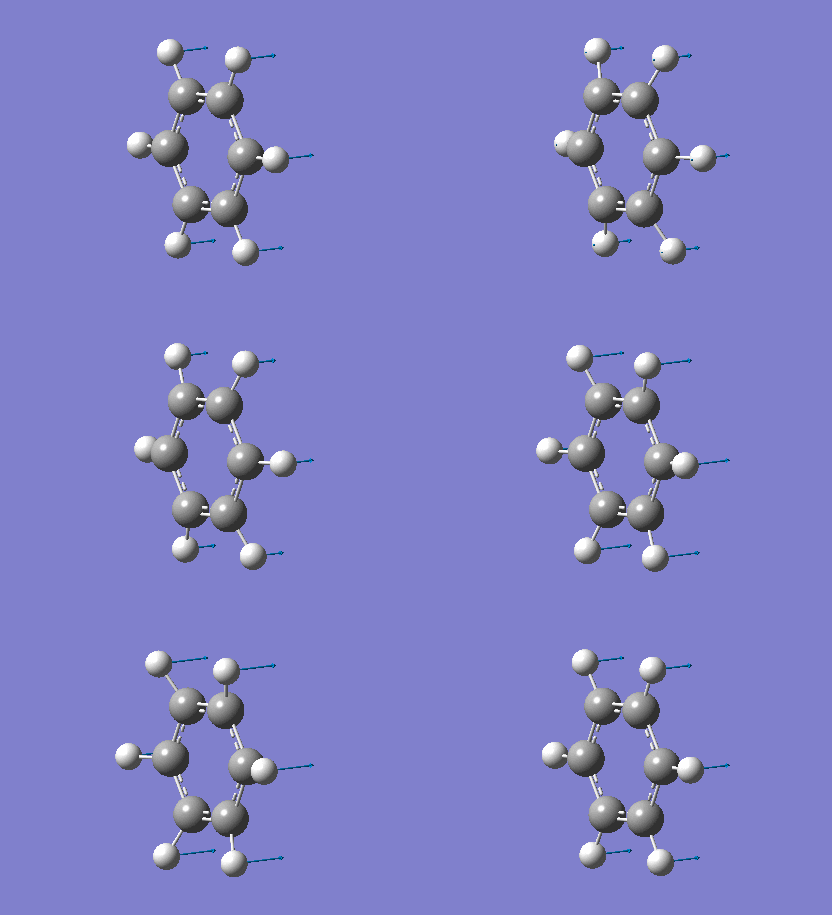
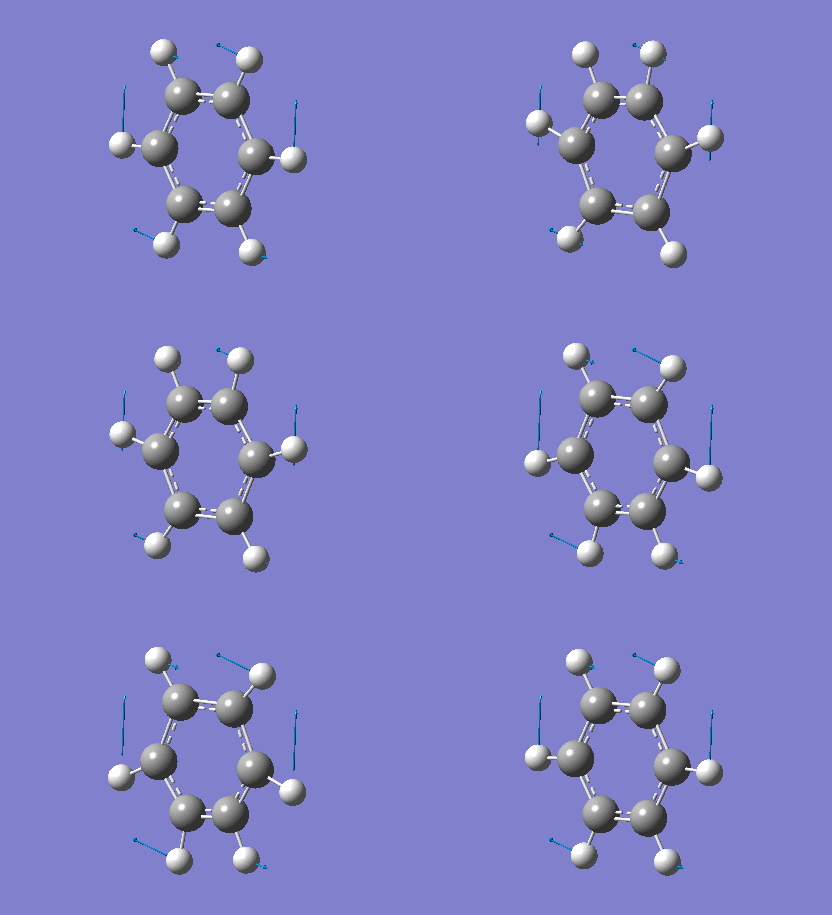
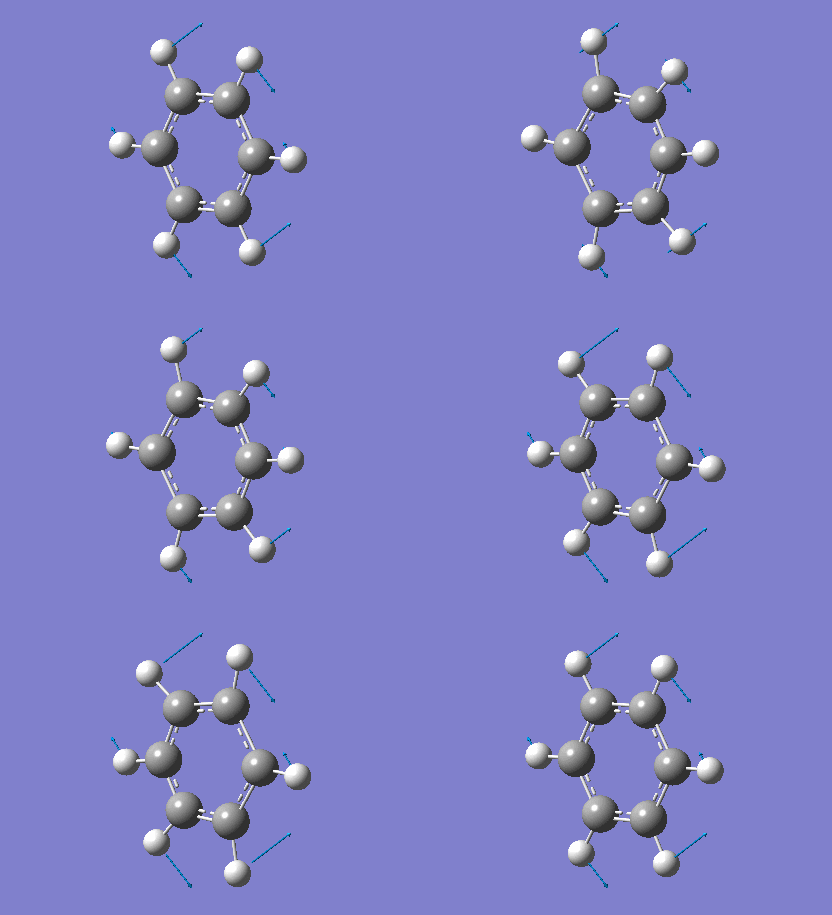
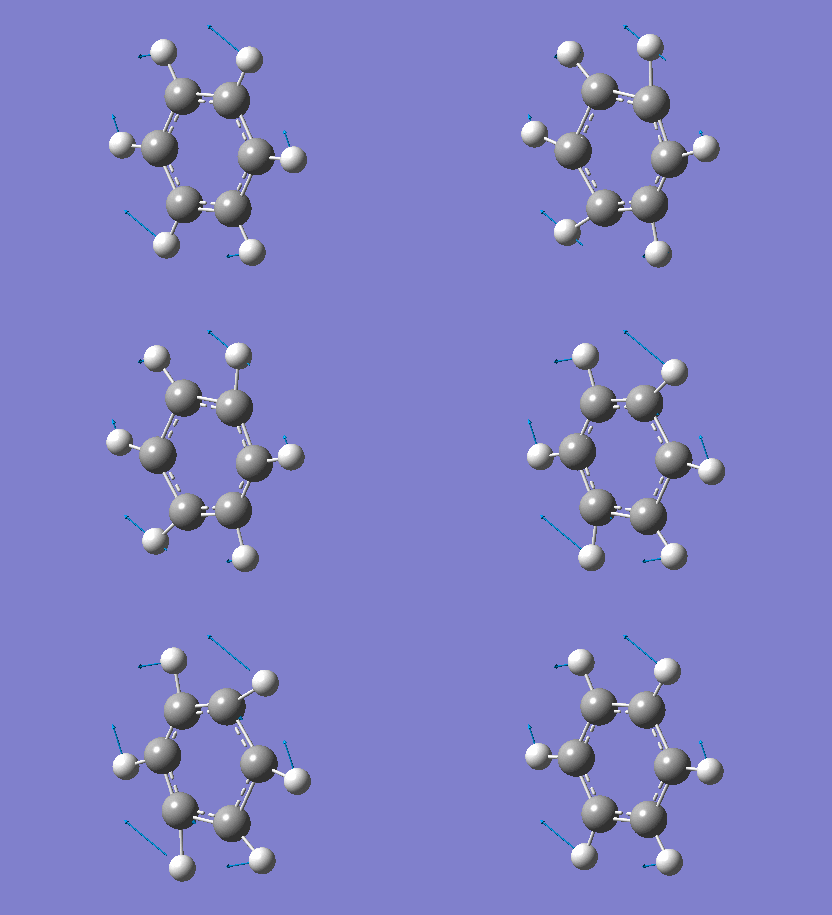
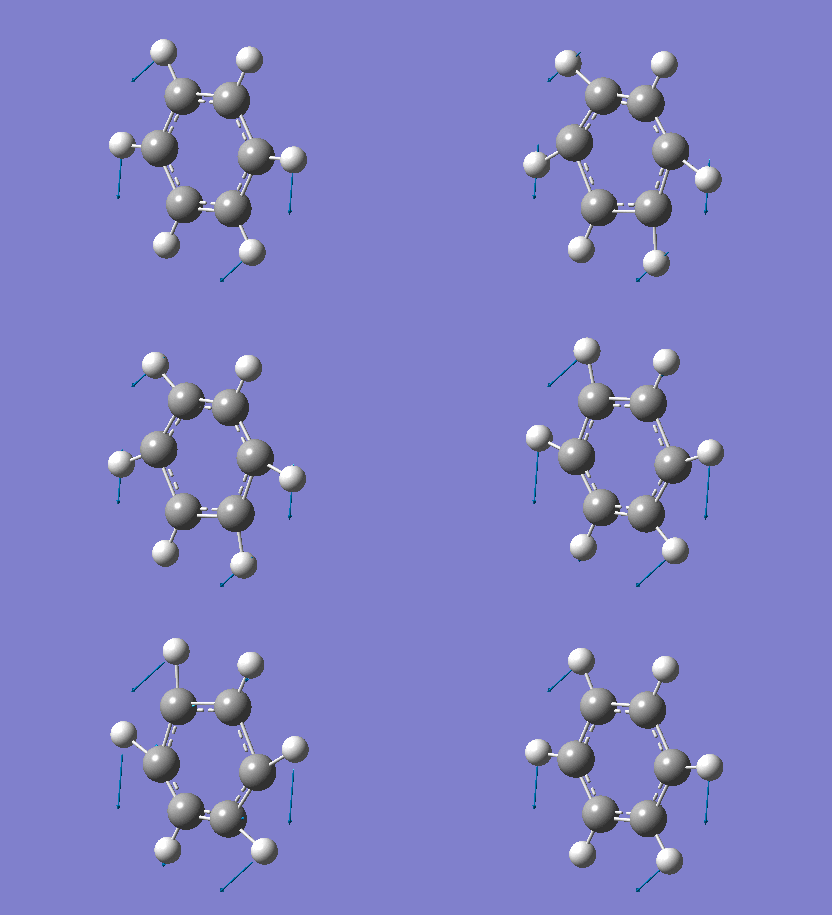
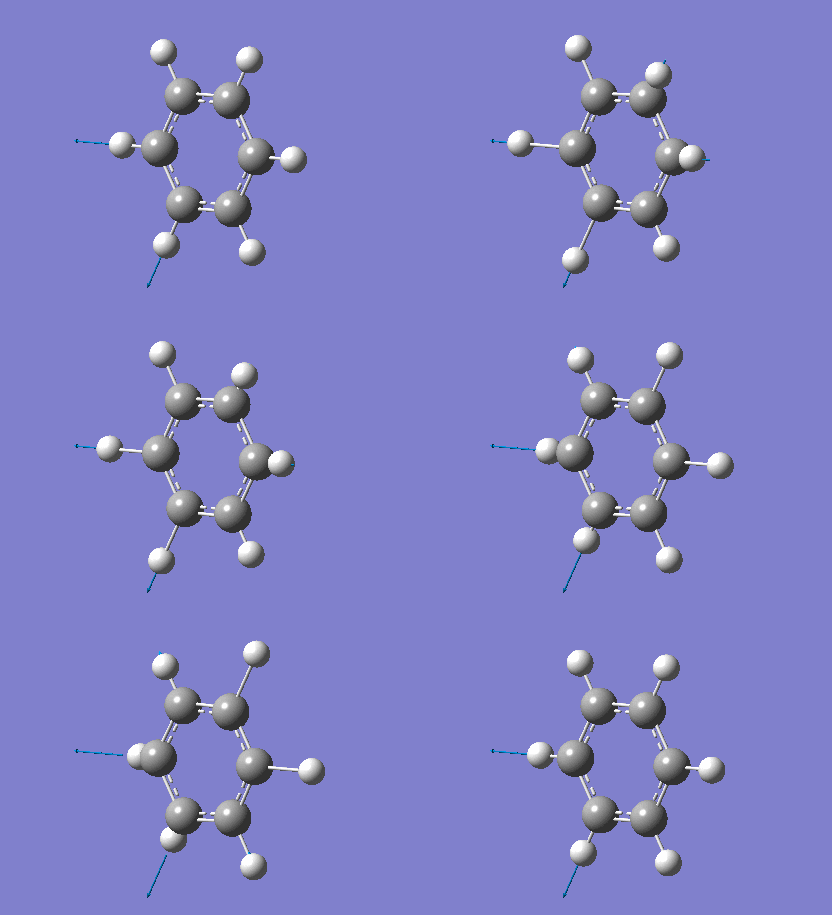
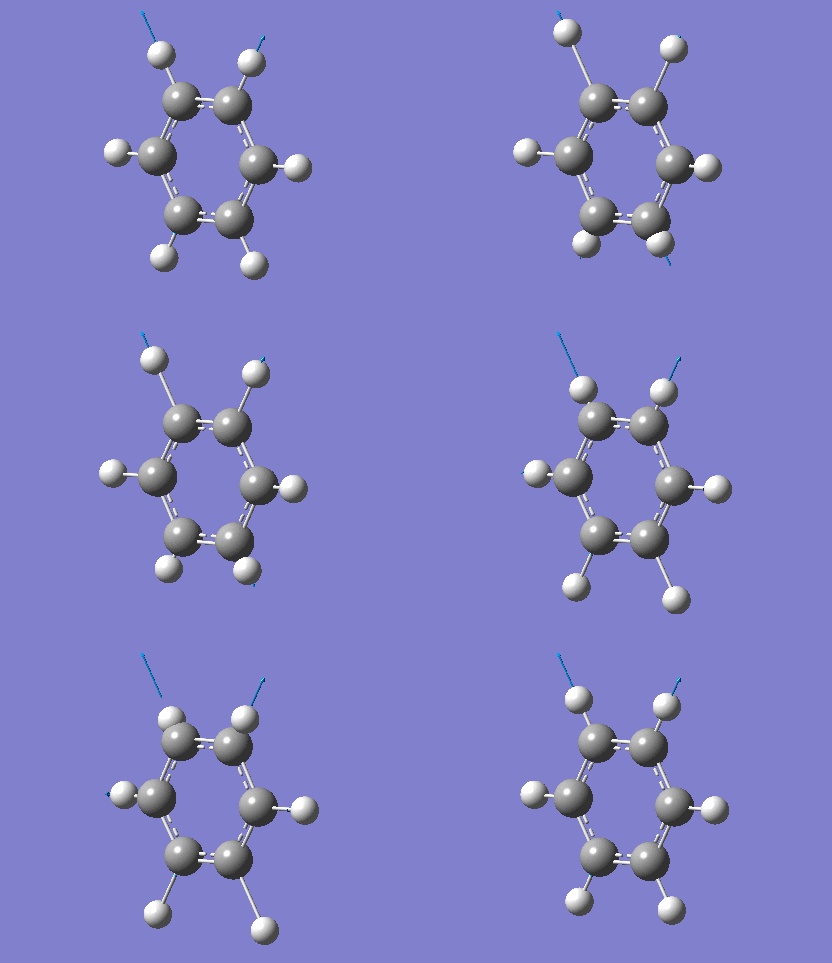
Thirty vibrational modes were identified for benzene, and the image to the left was taken from the GaussView results, showing the frequencies and intensities of all vibrations. The vibrations with positive intensities have been presented in the table below along with their corresponding symmetry labels, with links to the animations generated in GaussView.


| No. | Form of Vibration | Frequency | Intensity | Symmetry | Animation |
|---|---|---|---|---|---|
| 5 | All carbons stationary with hydrogens wagging in and out of the plane in a concerted motion | 692 | 74 | A2U | View Vibration 5 |
| 14 | All hydrogens rocking symmetrically in the plane of the molecule. The C-C bonds stretch slightly in response. | 1067 | 3 | E1U | View Vibration 14 |
| 15 | Degenerate with vibration 14. Identical motion, but with orthogonal plane of symmetry. | 1067 | 3 | E1U | View Vibration 15 |
| 21 | Three hydrogens rocking concertedly while the other three rock concertedly in the opposite direction. | 1525 | 7 | E1U | View Vibration 21 |
| 22 | Four hydrogens rocking concertedly. Two fold symmetry. Remaining two Hs and all carbons oscillate slightly. | 1525 | 7 | E1U | View Vibration 22 |
| 28 | Two pairs of neighbouring C-H bonds stretch symmetrically, but asymmetric to the other pair. The remaining bonds undergo a much smaller stretch. | 3201 | 47 | E1U | View Vibration 28 |
| 29 | Degenerate with vibration 28. Identical motion but on a different plane of symmetry. | 3201 | 47 | E1U | View Vibration 29 |
Boratabenzene:
Low frequencies ---  -13.0215  -0.0002 0.0007 0.0010 14.9001 18.1396
Low frequencies ---  371.3424 404.2362 565.2634
Pyridinium:
 Low frequencies ---   -7.2531  -0.0009  -0.0007  -0.0006 17.3498 18.5758
 Low frequencies ---  392.4576 404.0624 620.4718
Borazine:
 Low frequencies ---  -12.7779 -12.6030  -8.8046  -0.0102  -0.0083 0.0796
 Low frequencies ---  289.0619 289.0705 403.8121
NBO Analysis
| Benzene | Boratabenzene | Pyridinium | Borazine | ||||
|---|---|---|---|---|---|---|---|
 Charge distribution of Benzene |
 Charge Distribution for Boratabenzene |
 Charge distribution of pyridinium |
 Charge distribution of Borazine | ||||
 Position Labels for Boratabenzene |
 Position Labels on pyridinium |
 Position Labels on Borazine | |||||
| Range= -0.239 to 0.239 | Range= -0.588 to 0.588 | Range= -0.483 to 0.483 | Range= -1.102 to 1.102 | ||||
| Atom | Charge | Atom | Charge | Atom | Charge | Atom | Charge |
| Carbon | -0.239 | 12 (B) | 0.202 | 12 (N) | -0.476 | 10, 11, 12 (N) | -1.102 |
| Hydrogen | 0.239 | 1, 2 (C) | -0.588 | 1, 5 (C) | 0.071 | 7, 8, 9 (B) | 0.747 |
| 3, 5 (C) | -0.250 | 2, 4 (C) | -0.241 | 2, 4, 6 (H) | 0.432 | ||
| 4 (C) | -0.340 | 3 (C) | -0.122 | 1, 3, 5 (H) | -0.077 | ||
| 7 (H) | -0.096 | 11 (H) | 0.483 | ||||
| 6, 8 (H) | 0.184 | 6, 10 (H) | 0.285 | ||||
| 9, 11 (H) | 0.179 | 7, 9 (H) | 0.297 | ||||
| 10 (H) | 0.186 | 8 (H) | 0.292 | ||||
Benzene has six fold symmetry and a center of inversion, as this is evident from the charge distribution depicted in the above table. All carbons have equal negative charge and all hydrogens have equal positive charge. The electron density is distributed in this way since carbon is the more electronegative of the two species.
Looking now at borazine, which like benzene is symmetrical but three-fold instead, it is clear that the charge alternates with each atom around the ring. Nitrogen is the most electronegative atom here, and harbours the most negative charge. Boron is the most electropositive and hence bears the most positive charge. The hydrogen atoms as a result of this are split into two different environemnts; those bonded to nitrogen are positively charge (albeit less so than boron) and those bonded to boron have a negative charge (again a small charge compared to that on nitrogen).
The two ions generate an uneven charge distribution which can be explained by the presence of one heteroatom and a dipole moment. In boratabenzene, the boron atom is seen to be positive and hence the neighbouring atoms have a negative charge. All the carbons are again negative, but to different extents; those ortho to boron are the most negative, followed by the two para positions, and then the meta. To explain this distriubution we must look at the various resonance structures available to boratabenzene (below), which show how the charge can be situated on the ortho/para carbons, but not meta. As with borazine, the charge of each hydrogen is dependent on the atom to which it is bonded; therefore the H bonded to boron is negative, the meta-H is positive and the ortho/para-H's are slightly more positive.

Pyridinium behaves in the same way as boratabenzene, however here there is an extra positive charge, which can be situated on the ortho/para carbons, as shown in the resonance strutures above. Nitrogen is highly electronegative and the neighbouring ortho-carbons are positive as a result. The meta/para-carbons however are all negative, but as the figures show, the para carbon is less negative than the meta, due to the fact that it holds positive charge in resonance. The hydrogens are again charged according to the atom to which they are bonded to. This explains why the meta/para-H's are positive, however in this case the otho hydrogens are also positively charged, in spite of being bonded to positive carbons. This is due to the extent to which nitrogen withdraws electron density.
Molecular Orbital Analysis and MO Diagram for Benzene
| Benzene | Boratabenzene | Pyridinium | Borazine | |
|---|---|---|---|---|
| File Type | .log | |||
| Calculation Type | SP | |||
| Calculation Method | RB3LYP | |||
| Basis Set | 6-31G(d,p) | |||
| Charge | 0 | -1 | 1 | 0 |
| E(RB3LYP) (a.u.) | -232.25821387 | -219.02052981 | -248.66807395 | -242.68458225 |
| RMS Gradient Norm (a.u.) | n/a | |||
| Dipole Moment (Debye) | 0.0000 | 2.8467 | 1.8727 | 0.0000 |
| Point Group | D6H | C2V | C2V | D3H |
| Calculation Time (s) | 3 | 5 | 5 | 3 |
| Link to .log file | View file | View file | View file | View file |
The following Molecular Orbital diagram was constructed using the results of the Gaussian calculation. 'Real MOs' were used to generate corresponding LCAO representations.
The HOMO-LUMO region of the diagram can be inspected in order to relate the structure to the common conception of aromaticity.
Huckel aromaticity is defined by the 4n+2 rule, where this is the number of π-electrons in the molecule. In benzene, MOs 17, 20, 21, 22 and 23 are π-based. Only the lower three of these are occupied, i.e. there are 6 π-electrons and the 4n+2 rule applies (n=0). Since these delocalised electrons are valence electrons, they are dominant in dictating the reactivity of the molecule. It is also expected for an aromatic compound to be planar, and it is evident from the computed MOs that benzene is indeed planar.
Usually, aromaticity is described in terms of delocalised electrons and related to the all-in-phase p-orbital interaction in a system (in benzene this would be MO 17). The MO diagram here helps to demonstrate that in fact aromaticity is a result of contributions from many different molecular orbitals, and hence MO Theory could be used to explain how the commonly applied 'criteria' stated earlier may non be true for some aromatic compounds, (for example, non-planar aromatics structures[2] can exist).
| MO Coefficient | Energy | MO Coefficient | Energy | MO Coefficient | Energy | ||
|---|---|---|---|---|---|---|---|
| 7 | -0.84678 | 14 | -0.43854 | 22, 23 | 0.00267 | ||
| 8, 9 | -0.74005 | 15, 16 | -0.41657 | 24 | 0.09117 | ||
| 10, 11 | -0.59740 | 17 | -0.35999 | 25, 26 | 0.14516 | ||
| 12 | -0.51795 | 18, 19 | -0.33961 | 27 | 0.16190 | ||
| 13 | -0.45822 | 20, 21 | -0.24691 |

| Benzene | Boratabenzene | Pyridinium | Borazine | Discussion | |
|---|---|---|---|---|---|
 E= -0.35999 |
 |
 E= -0.13208 |
 E= -0.64064 |
 E= -0.36129 |
These molecular orbitals represent a totally π bonding interaction (as depicted in the LCAO interpretation) which results in two bonding surfaces above and below a nodal plane. Substituting a carbon atom in benzene for a boron atom raises the energy of the MO slightly, whereas substituting for nitrogen leads to a lowering of energy. This can be explained by the differences in electronegativity; increasing electronegativity of an atom in the ring results in a stabilisation of the delocalised charge and therefore an overall stabilisation of the MO. The energy change on substituting for B and N are approximately equal and opposite. In borazine, both of these effects are observed to the same extent (3 carbons each), and therefore there is no significant change in energy of the MO. |
 E= -0.24691 |
 |
 E= -0.03493 |
 E=-0.47885 |
 E= -0.27590 |
Two π bonding interactions in the benzene ring result in the molecular orbital shown on the far left, containing 4 surfaces and 2 nodal planes orthogonal to each other. The corresponding MOs in the 3 analogues on benzene take on an equivalent shape and phase pattern. In pyridinium and boratabenzene, the heteroatom exists in the nodal plane perpendicular to the plane of the ring, and therefore their AOs do not participate in formation of the MO. Therefore to explain the relative energies, the NBO analyses of the molecules must be considered. Heteroatoms lead to a uneven charge distribution; boron makes the neighbouring carbons more negative, whereas nitrogen withdraws electron density and makes the neighbouring carbons more positive, stabilising the MO. |
 E= -0.24691 |
 |
 E= 0.1093 |
 E= -0.50847 |
 E= -0.27590 |
These MOs are similar to the set above, however each surface now spans three in-phase p orbitals on either side of the ring. Again, two nodal planes are present, however no atoms lie within the plane orthogonal to the ring. The relative energies follow the same sequence as before.
For borazine and benzene, these MOs and the pair above are degenerate in energy, due to their high order symmetry. In pyridinium and boratabenzene (both C2v) the degeneracy has been lost, due to the lower order symmetry, and there is also a reordering of the MO; pyridinium shows a lower energy for the MO which involves the nitrogen p-AO (this AO can bear more negative charge and stabilise the MO). |
Based on the descriptions in the table above, it is expected that the MO diagram of borazine would look very similar to that of benzene; the energies have been shown to be approximately equivalent and the degeneracy is also the same. Boratabenzene and pyridinium however would have shifted energies of the MOs (boratabenzene to higher energies and pyridinium to lower energies) and the degeneracy would be lost. Overall it is expected that the spacing between energy levels would be similar to the benzene MO diagram.
Conclusion
Optimisations on benzene and the three isoelectronic analogues were successfully carried out using Gaussian, and confirmed by subsequent frequency analyses. In order to investigate the molecular orbital structure of the molecules, Gaussian was used to conduct an Natural Bonding Orbital analysis on each aromatic compound. Point groups were constrained to keep accurate symmetry, and to allow the symmetry labels of MOs to be identified. Using benzene as a reference, the effect of substituting an atom on the ring was inspected. It was found that the boratabenzene anion and the pyridinium anion underwent shifts in energies, and a loss of degeneracy due to the breaking of benzene's D6h symmetry to C2v. The borabenzene energies were higher relative to benzene, and pyridinium anion was more stabilised. The effect of substituting all carbons, to give borazine, was minimal. The symmetry was reduced, to D3h, but the degeneracy was not affected since this is still higher order symmetry than C2v. The sigma and pi bonding interaction MOs were computed and an MO diagram constructed for this region (the core orbitals were not included since these are too low in energy). The 'real' molecular orbitals were deconstructed into LCAO representations, in order that we may understand the orbitals in terms of the common criteria for aromaticity. An estimation of the the full MO diagram for benzene's analogues was described, and the charge distribution diagrams computed in GaussView were helpful in explaining the differences in ordering of MO energies for pyridinium.
Further Study
The computational process used here could be implemented further in this area, perhaps to investigate the following:
- •The effect substituting a carbon in benzene for heteroatoms other than boron and nitrogen
- •Substituted benzene; the effect of different groups in place of hydrogen on a benzene ring.
- •The aromaticity of smaller aromatic rings, for example pyrrole, furan, thiophene etc
- •The MO diagram of benzene-like strucutres after loss of aromaticity.
References
- ↑ Schleyer, Paul von Ragué (2005). "Introduction: Delocalization Pi and Sigma". Chemical Reviews 105(10): 3433. DOI:10.1021/cr030095y ]
- ↑ [T. Yao, H. Yu, R. J. Vermeij, G. J. Bodwell; 2008; Nonplanar aromatic compounds. Part 10: A strategy for the synthesis of aromatic belts; Pure and Applied Chem. 80(3):533–546;DOI:10.1351/pac200880030533 ]