
Rep:Mod:01327212
NH3 Molecule
Optimisation
Calculation Method : RB3LYTP
Basis Set : 6-31G(d,p)
E(RB3LYP) : -56.55776873 a.u.
RMS Gradient : 0.00000485 a.u.
Point group : C3V
N-H bond Length : 101.8pm
H-N-H bond angle : 105.7 degrees
 Item                     Value        Threshold    Converged?
 Maximum Force            0.000004     0.000450     YES
 RMS     Force            0.000004     0.000300     YES
 Maximum Displacement     0.000072     0.001800     YES
 RMS     Displacement     0.000035     0.001200     YES
 Predicted change in Energy=-5.986276D-10
 Optimization completed.
    -- Stationary point found.
NH3 |
<script>frame x.y</script>
The optimisation file is liked to here
Vibrations and Charges
The Display Vibrations Screenshot is liked to here
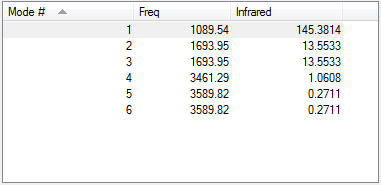
How many modes do you expect from the 3N-6 rule? 3N-6=3*4-6=6
Which modes are degenerate (ie have the same energy)? Two modes (freq=1693.95 & freq=3589.82)
Which modes are "bending" vibrations and which are "bond stretch" vibrations? Three bending and three stretch
Which mode is highly symmetric? The mode with frequency=3461.29
One mode is known as the "umbrella" mode, which one is this? The mode with frequency=1089.54
How many bands would you expect to see in an experimental spectrum of gaseous ammonia? Four
The charge on N atom is -1.125 and the charge on H atom is 0.375. N atom is negative and H atom is positive, because the electronegativity of N is larger than that of H.
H2 Molecule
Calculation Method : RB3LYTP
Basis Set : 6-31G(D,P)
E(RB3LYP) : -1.17853930 a.u.
RMS Gradient : 0.00012170 a.u.
Point group : Dinfh
H-H bond Length : 74.3pm
H-H bond angle : 180 degrees
Item                     Value        Threshold    Converged?
Maximum Force            0.000211     0.000450     YES
RMS     Force            0.000211     0.000300     YES
Maximum Displacement     0.000278     0.001800     YES
RMS     Displacement     0.000393     0.001200     YES
Predicted change in Energy=-5.852867D-08
Optimization completed.
   -- Stationary point found.
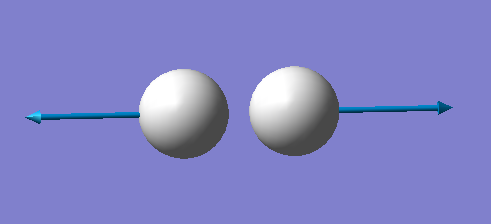
The H2 Vibration Screenshot is liked to here
N2 Molecule
Calculation Method : RB3LYTP
Basis Set : 6-31G(D,P)
E(RB3LYP) : -109.52412868 a.u.
RMS Gradient : 0.00000365 a.u.
Point group : Dinfh
N-N bond Length : 11.1pm
N-N bond angle : 180 degrees
Item                     Value        Threshold    Converged?
Maximum Force            0.000006     0.000450     YES
RMS     Force            0.000006     0.000300     YES
Maximum Displacement     0.000002     0.001800     YES
RMS     Displacement     0.000003     0.001200     YES
Predicted change in Energy=-1.248810D-11
Optimization completed.
   -- Stationary point found.
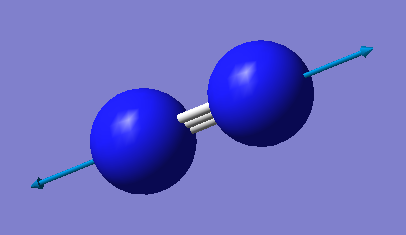
The N2 Vibration Screenshot is liked to here
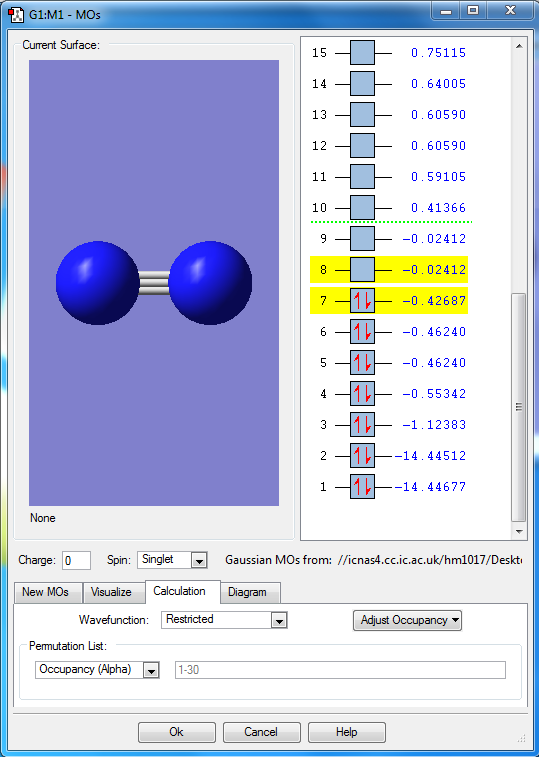
The N2 MO is liked to here
Reaction Energy
N2 + 3H2 -> 2NH3
E(NH3)= -148492.43kJ/mol
2*E(NH3)= -296984.86kJ/mol
E(N2)= -287555.62kJ/mol
E(H2)= -3094.26kJ/mol
3*E(H2)= -9282.78kJ/mol
ΔE=2*E(NH3)-[E(N2)+3*E(H2)]= -146.46kJ/mol
The product(NH3) is more stable because the total energy of products is less than the total energy of reactants.
O2 Molecule
Optimisation
Calculation Method : RB3LYTP
Basis Set : 6-31G(D,P)
E(RB3LYP) : -150.25742434a.u.
RMS Gradient : 0.00008890a.u.
Point group : Dinfh
O=O bond Length : 121.6pm
O=O bond angle : 180 degrees
Item                     Value        Threshold    Converged?
Maximum Force            0.000154     0.000450     YES
RMS     Force            0.000154     0.000300     YES
Maximum Displacement     0.000094     0.001800     YES
RMS     Displacement     0.000133     0.001200     YES
Predicted change in Energy=-1.449648D-08
Optimization completed.
   -- Stationary point found.
O2 |
<script>frame x.y</script>
The optimisation file is liked to here
Vibrations and Charges
The Display Vibrations Screenshot is liked to here

How many modes do you expect? 3N-5=3*2-5=1 (O2 is linear, so using 3N-5 rule)
How many bands would you expect to see in an experimental spectrum of gaseous O2? Zero. Because the O2 molecule is non-dipole.
The O2 charges Screenshot is liked to here

The charge on both two O atom is zero, this molecule is non-dipole.
Molecular Orbitals
The O2 MO Screenshot is liked to here
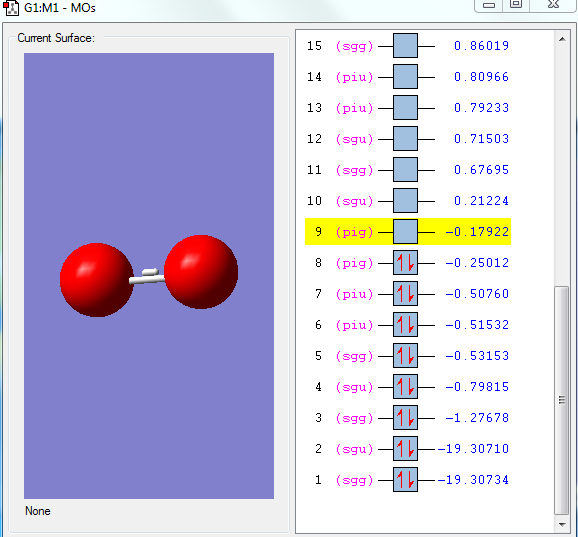
The O2 MO drawing is liked to here
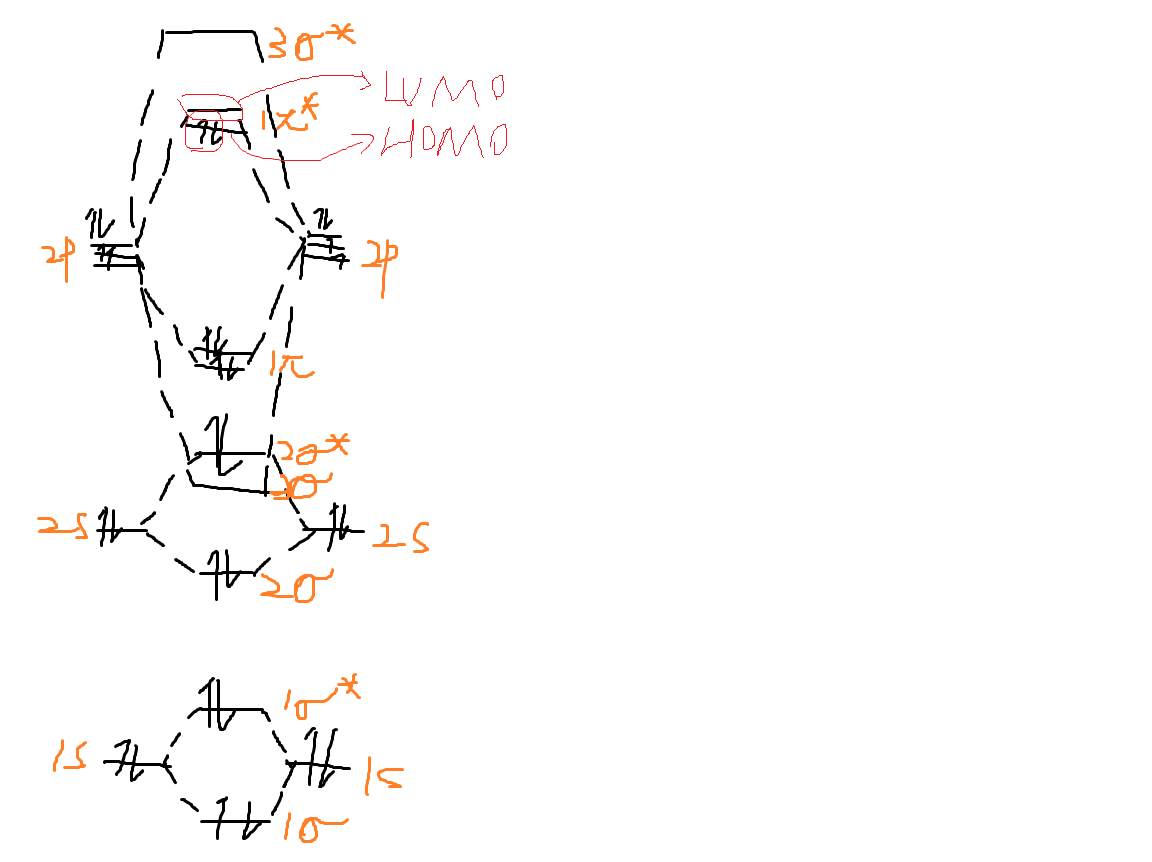
Questions for analysis of the five MOs below ː What AOs contribute to the MO? Is the MO bondng, antibonding or a mixture? Is the MO deep in energy, in the HOMO/LUMO region or high in energy? Is the MO occupied or unoccupied? What effect will MOs have on bonding?
MO 1
The O2 MO1 Screenshot is liked to here

Two 1s AOs form this sigma bonging MO. It is occupied.It has no effect on bonding since its energy is too low. This pair of electrons will be lone pairs for the molecule.
MO 2
The O2 MO2 Screenshot is liked to here
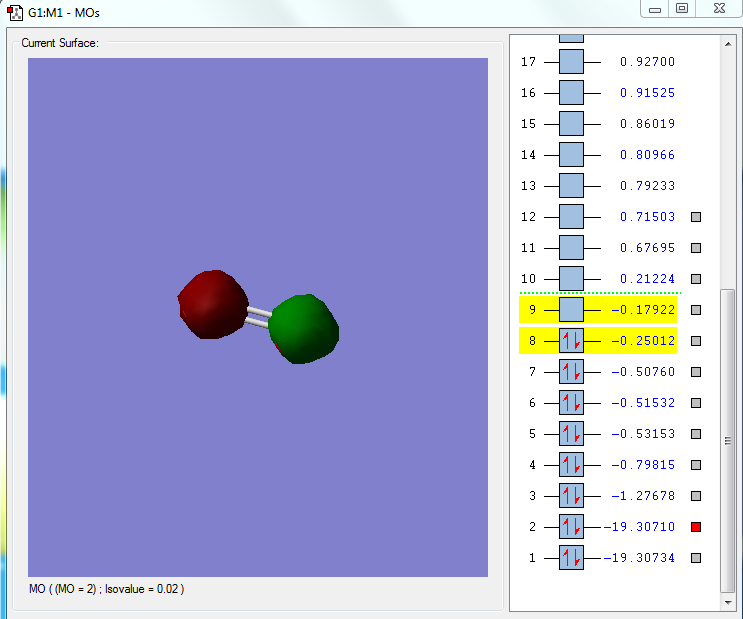
Two 1s AOs form this sigma antibonging MO. It is occupied. It has no effect on bonding since its energy is too low. This pair of electrons will be lone pairs for the molecule.
MO 3
The O2 MO3 Screenshot is liked to here
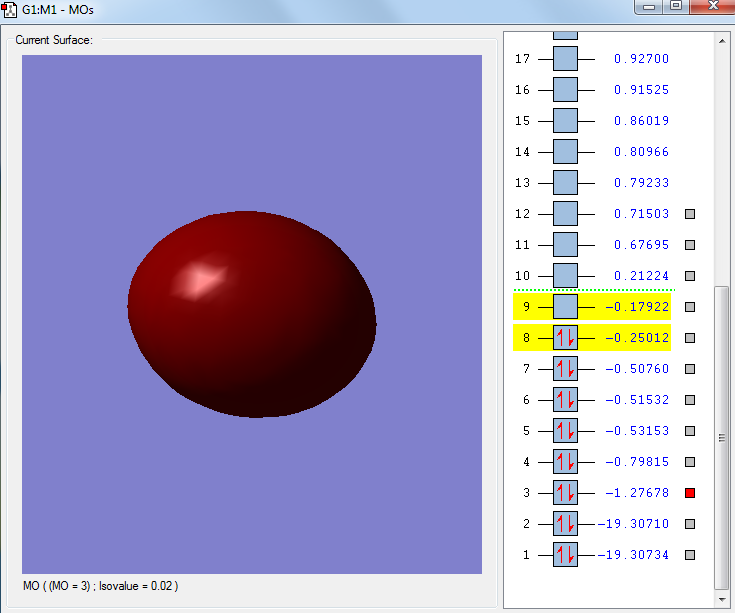
Two 2s AOs form this sigma bonging MO. It is occupied.
MO 4
The O2 MO4 Screenshot is liked to here
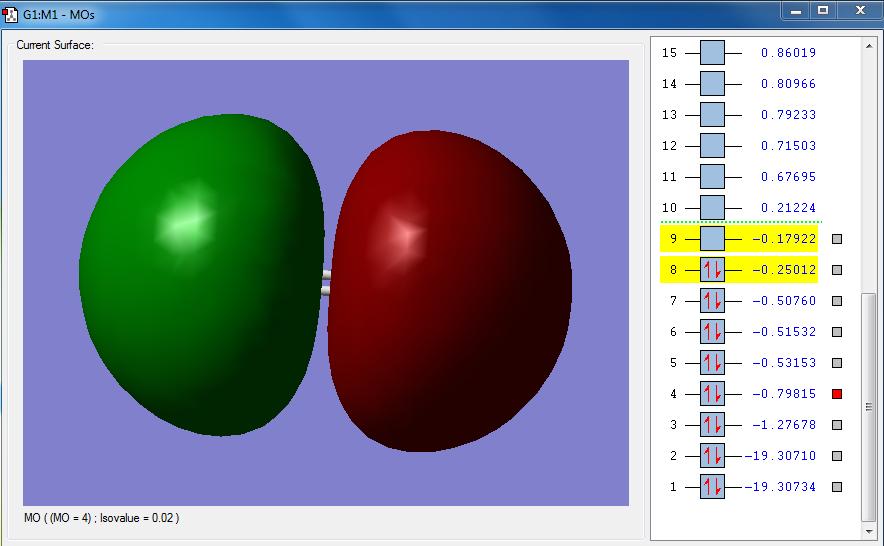
Two 2s AOs form this sigma antibonging MO. It is occupied.
MO 5
The O2 MO5 Screenshot is liked to here

Two 2p AOs form this sigma bonging MO. It is occupied.
MO 6
The O2 MO6 Screenshot is liked to here

Two 2p AOs form this pi bonging MO. It is occupied.
MO 7
The O2 MO7 Screenshot is liked to here
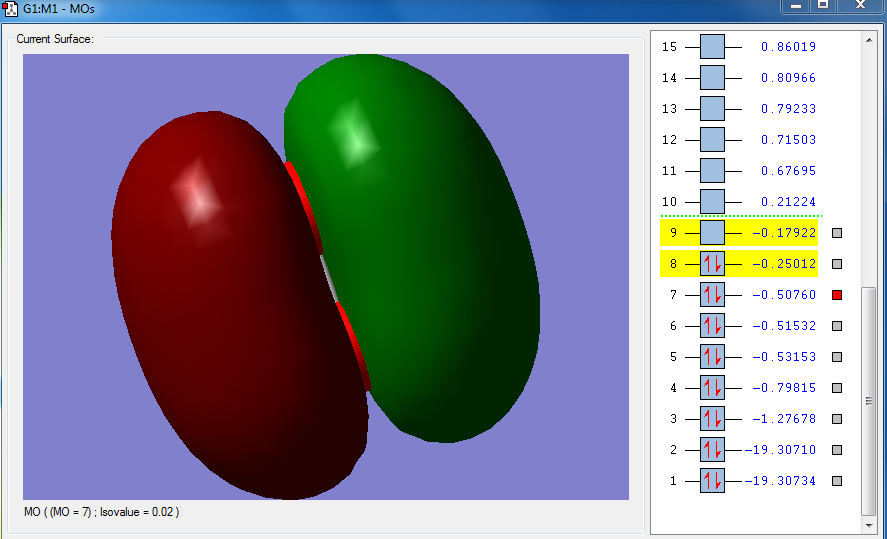
Two 2p AOs form this pi bonging MO. It is occupied.
MO 8
The O2 MO8 Screenshot is liked to here

Two 2p AOs form this pi antibonging MO. It is occupied. And it is HOMO.
MO 9
The O2 MO9 Screenshot is liked to here

Two 2p AOs form this pi antibonging MO. It is unoccupied. And it is LUMO.